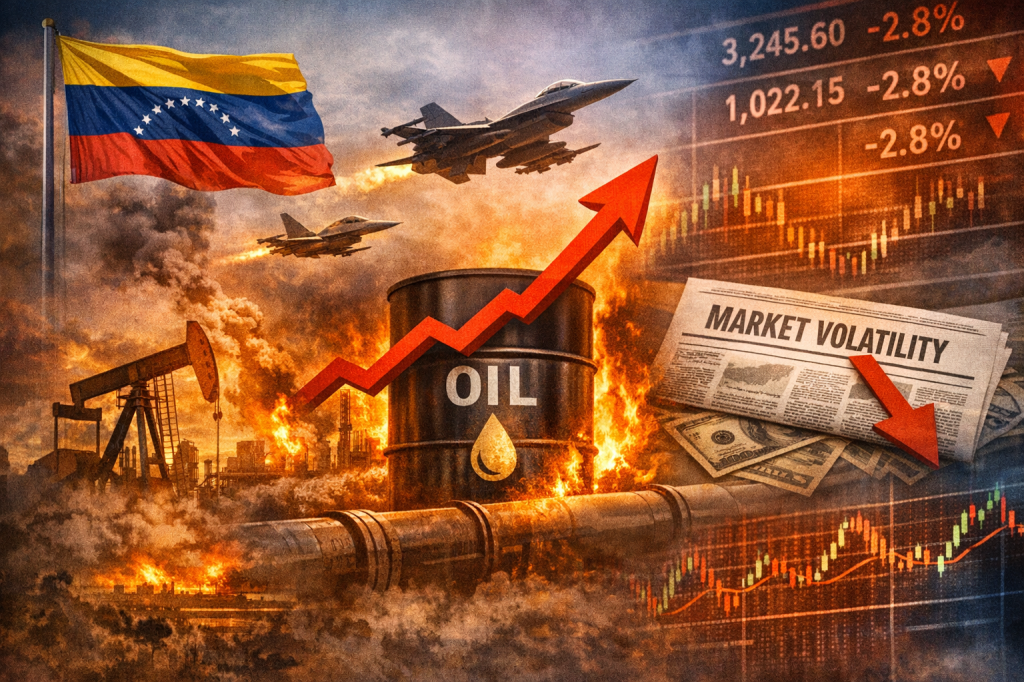
Geopolitical conflicts often feel abstract—until markets react. A potential war involving Venezuela may seem geographically distant, but history suggests it could have a very real impact on my investment portfolio.
Venezuela holds some of the world’s largest proven oil reserves. Any escalation involving the country immediately raises concerns about oil supply disruptions, sanctions, or export constraints. Even when physical supply is not immediately affected, markets tend to price in risk quickly. Historically, conflicts involving major energy producers—from the 1973 oil embargo to the Russia–Ukraine war—have been associated with sharp increases in oil prices and higher volatility across global markets.
For my portfolio, higher oil prices matter in several ways. Energy-driven inflation can push up interest rates, which tends to pressure growth stocks and bonds. Consumer-facing companies may face margin compression as input and transport costs rise. At the same time, energy stocks and commodity-linked assets may benefit, at least in the short term. The result is often uneven performance across sectors rather than a uniform market move.
There is also a broader sentiment effect. Emerging markets typically experience increased volatility during geopolitical shocks, even when the conflict is localised. Investors often reduce risk exposure across the asset class, which can temporarily weigh on returns regardless of underlying fundamentals.
What history consistently shows, however, is that markets tend to adjust and stabilise once uncertainty becomes clearer. Short-term volatility does not always translate into long-term damage for diversified investors. For me, events like this reinforce the importance of diversification, maintaining exposure across asset classes and regions, and avoiding reactive decisions driven by headlines.
A Venezuela war would not just be a geopolitical story—it would be a reminder that global events, especially those tied to energy markets, have a habit of finding their way into personal portfolios. The goal isn’t to predict conflict, but to be financially prepared when uncertainty inevitably arrives.
 VahishtaInvest